

|
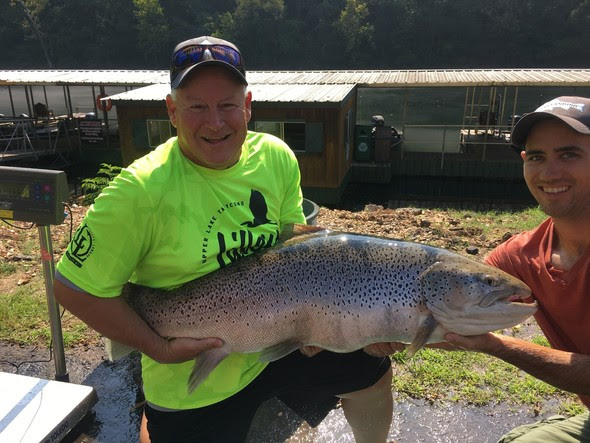
MDC confirms new state record brown trout caught at Lake TaneycomoBlue Eye angler Bill Babler set the record with a 40-pound, 6-ounce fish. JEFFERSON CITY, Mo. – The Missouri Department of Conservation (MDC) confirms Bill Babler of Blue Eye is now the new state-record holder for brown trout after catching a monster 40-pound, 6-ounce fish at Lake Taneycomo Sept. 4 using a pole-and-line. The previous record was set just seven months ago by Paul Crews of Neosho. Crews was also fishing at Lake Taneycomo when he reeled in a 34-pound, 10-ounce brown trout Feb. 23 using a pole-and-line. Babler told the Springfield News-Leader he’d only been out fishing for a few minutes when he caught the fish. “As soon as I set the hook it came to the top and I knew we had a good fish on,” Babler told the newspaper. “We positioned the boat in an unobstructed area. It was pulling drag pretty good!” Babler attempted to keep the behemoth alive in an aerated tank, but unfortunately the trout died before it could be released. MDC staff verified Babler’s record-breaking catch on a certified scale in Branson. Fisheries Management Biologist Shane Bush confirmed the fish was eight or nine-years-old. Missouri state-record fish are recognized in two categories: pole-and-line and alternative methods. Alternative methods include: throwlines, trotlines, limb lines, bank lines, jug lines, spearfishing, snagging, snaring, gigging, grabbing, archery, and atlatl. For more information on state-record fish, visit the MDC website at https://short.mdc.mo.gov/Z3t. To find a place to fish near you, download MDC’s mobile app, Mo Fishing, available for iPhone devices in the App Store and Android devices in Google Play.
Bill Babler (left) holds the new state-record brown trout with his friend Ryan Titus. The fish was caught Sept. 4 at Lake Taneycomo, weighing in at 40-pounds, 6-ounces. |
|
Find this and other MDC media releases in our MDC online Newsroom. |
Club News
No Sept Fly tying nite
Unfortunately both Jeff and myself will be unavailable for our September Fly Tyers Session. Hopefully we will a be able to get back to our regular 2nd Tuesday of each month sessions starting in October. Hope you all had a fun and productive summer and have lots of interesting fishing adventures to tell us all about. Also please remember all your favorite successful flies so we will have some interesting new flies to tie.
Until our next meeting.
Gary
Tips on personal watercraft
|
Nov 16th Holdover Tournament

NOV16
2019 Guadalupe Holdover Tourney· Hosted by Texas Holdover Tournament and New Braunfels Fly Fishers
|
Saturday, November 16, 2019 at 8 AM – 4 PM
|
|
Action Angler & Outdoor Center- Guadalupe River, New Braunfels, TX
9751 River Rd, New Braunfels, Texas 78132
|
Llano river is recovering
Large Numbers of Juvenile Bass Indicate Llano River Recovering From Historic Flood Event
AUSTIN – Less than a year after a major flood scoured much of the Llano River and left anglers worried about the future of the waterway’s renowned bass fishery, biologists with the Texas Parks and Wildlife Department are finding evidence of a recovery.
A fish sampling effort near Castell in late-June by TPWD aquatic biologists found large numbers of juvenile largemouth and Guadalupe bass are now present in the river. TPWD Aquatic Biologist Preston Bean, who is heading up a study looking at recovery of the river’s habitat and fish assemblage, reported Guadalupe bass made up 26 percent of the total catch and were at least 10 percent of the catch at each of 10 sampling sites.
“Most Guadalupe bass we collected were spawned this spring and the average length was 2.2 inches,” said Bean. “The fish appeared to be feeding heavily and had excellent body condition.”
The health of the resource was also evident from sampling of other aquatic species present in the river. Archis Grubh, TPWD Aquatic Ecologist who is studying effects of the flood on aquatic invertebrates reported seeing a steady repopulation of the invertebrate community, which means plentiful food is available for juvenile sport fish.
While biologists note that it will take time for keeper-sized bass to reach pre-flood levels in the Llano River, the presence of large numbers of juveniles indicates the fishery is healthy and on the way to recovery. Based on average growth rates for bass from Hill Country rivers, it will likely take several years before good numbers of larger bass are available for anglers in the most affected reaches of the river. Follow-up fish, habitat, and aquatic invertebrate surveys are planned by TPWD in the months ahead, along with surveys to monitor for aquatic invasive species that often spread during flood events.
“Keep in mind, last year the Llano River was greatly affected by a 100-year flood event that significantly altered its fish habitat,” said John Botros, TPWD River Access Program Coordinator. “Many anglers and local landowners expressed concern to us about the status of the fish population following this catastrophic flooding. While the abundance of fish in the river is lower than it was before the flood, we are happy to report that fish populations are showing signs of recovery.”
More information on the Llano River flood of 2018, including details on changes to aquatic and riparian habitats can be found on the Llano River Watershed Alliance’s website.