Casting videos

May be an image of fishing, fishing rod and text that says 'ROLL ROLLCAST CAST'
If you’re new to fly fishing, mastering a few key casts makes all the difference. Start with the roll cast, a forward cast that doesn’t require a back cast. It’s ideal when trees or brush block your back cast or when you need to remove slack from your line. Simple, practical, and fun to learn, it’s the one cast every angler should know.
In this video, Master Casting Instructor Bruce Richards, who helped develop FFI’s Casting Instructor Certification Program (CICP), walks you step-by-step through how to roll cast like a pro.
Watch this and other helpful videos here (tinyurl.com/ffi-fly-casting), and consider pairing your online learning with in-person lessons from FFI Certified Casting Instructors.
FFI’s Fly Casting Education Program also offers videos, articles, casting events, and a global network of expert instructors to help you keep improving.

First Annual Guadalupe Casting Cup

Folks,

Attached is an invitation from Rio Guadalupe Fly Shop to participate in their first annual casting cup on June 14th.
Casting demos and competitions for all levels of experience.
Hope you can make it.  Unfortunately I will be out of town that weekend.
Pat
Guadalupe Casting Cup.png

Essential river casts

This episode of the Far Bank Fly Fishing School series focuses on a selection of essential casts that all river anglers should know. Some of the casts in this episode allow anglers to fish in situations that they wouldn’t normally be able to do so knowing only the overhead cast, while other casts create better ways to present the fly to the fish and increase the odds of getting it to eat. Whether you’re a first-time river fly fisher, someone who has fished rivers in the past but wants to up their game, or you just want to learn some really cool, highly useful casts this episode is for you. In this episode Far Bank head fly fishing instructor Simon Gawesworth, explains and demonstrates how to learn and master the roll cast, the side cast, the reach cast, the aerial mend, and shows a number of ways to make a slack line cast – all casts that will help you greatly increase your success on the water.

Red’s Tired of Tangling Your Nymph Rig?

Are spending more than 10% of your time dealing with snags, tangles, and other pesky interruptions?

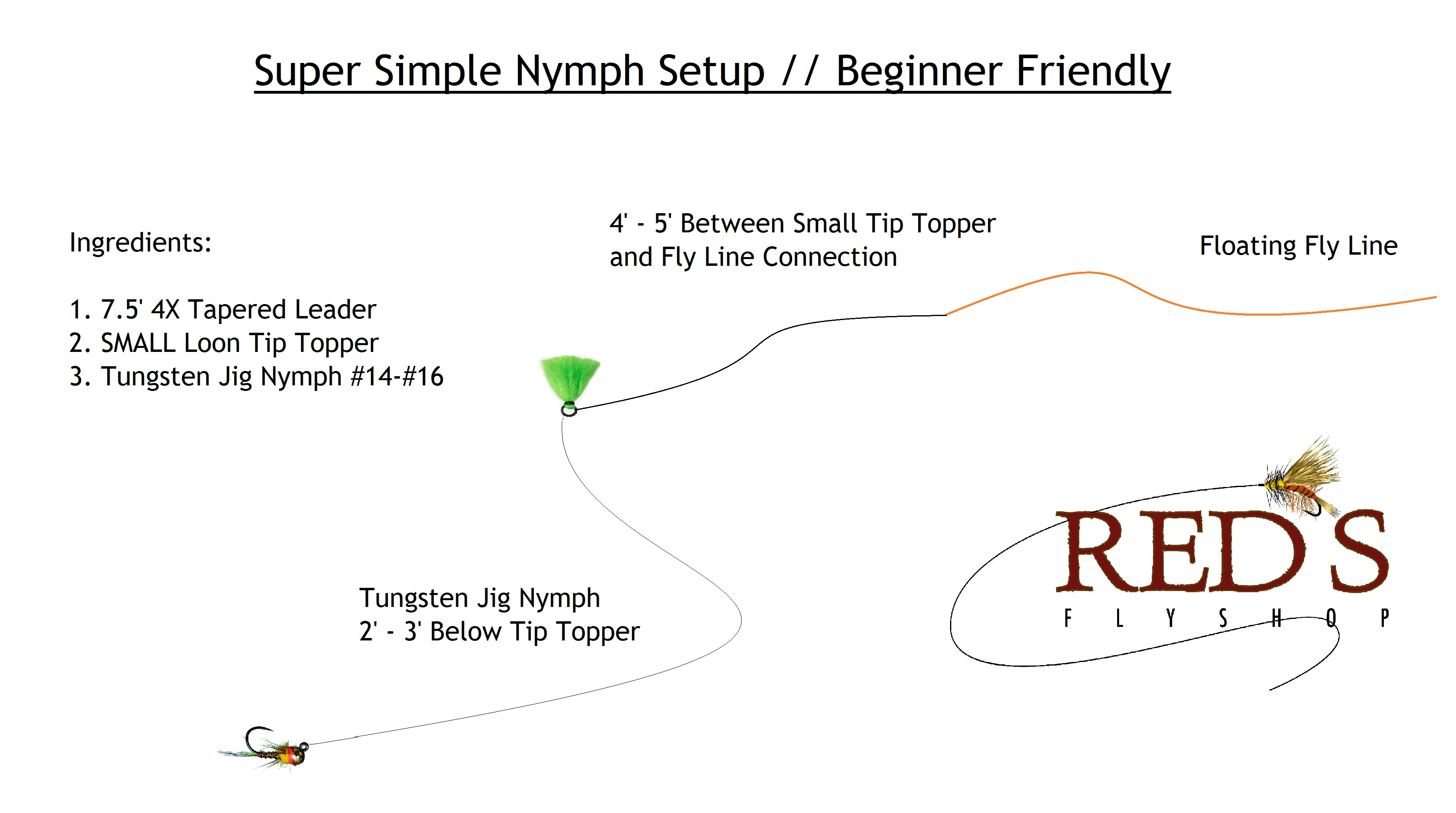
At Red’s we use this rig in many of our University of Fly Fishing clinics and see great success.  Anglers experience efficiency and suffer less negative distraction. Your setup should be a joy to fish and cast, this rig in the diagram below does just that.  In order for you to get good at drifting and presenting a fly you need REPS.  Many reps.  Lots of casts, thousands of drifts.  An angler must have a smooth and efficient tempo, presenting their fly over and over again and in this process they become skilled. You’ll become a Ninja in no time if you can just stay untangled!

Many anglers spend half of their time retying and untangling some complicated rig they learned on YouTube. Probably from Red’s haha and that’s a shame.  Simple is awesome.  Follow this recipe, get back to the basics and go have a great time moving fluidly throughout your fishery.

While there are anglers that can and should utilize more complex rigs, if you are looking to improve your fishing abilities; the “Keep it Simple Stupid” approach is best.  If some things on the list below annoy you while fishing, try the setup diagramed here and free yourself of distraction. You’ll be faster to rig up, and now able to focus on all the other skills like mending, stalking trout, and reading water because you won’t be picking apart a birds nest every 5-10 minutes at 15 minutes a pop.

Threats to a Nymph Angler’s Tempo and Efficiency:

  1. Tangling your fly/indicator/tippet
  2. Snagging Bottom (most of the time your nymph really just needs to be in the bottom HALF of the water column)
  3. Snagging Behind You
  4. Standing on Your Line (or snagging your handling line in the grass/shrubs)
  5. Trying to cast too far
  6. Trying to feed too much slack line downstream
  7. Changing flies too much
  8. Setups that take too long setup (2 fly rigs)
  9. Not Having a Well Developed Casting Strategy (consistent use of roll, overhead, or water based casts) for every drift. Simple rigs will help you develop this.
  10. Nymph setups that are too heavy (see #1 and #2)
Nymph Setup Diagram

The Pro’s Notes:

  • Indicator MUST be position and the point on the leader where the taper is most extreme.  This leaves exclusively fine tippet below the indicator allowing the nymph to sink fast and suspend directly below the indicator.
  • 7.5′ 4X Leaders are perfect for this. 9′ leaders can be more challenging to cast. You can repair your leader with Fluorocarbon tippet, but don’t overthink this. Start with a leader right out of the package.  No tippet material required.
  • Yarn as an indictor material is essential. To fish a nymph suspended it must float slower than the surface currents. The weight of a Tungsten nymph will actually slow the yarn down.  Other “bobbers” won’t do this.
  • Tungsten Jig Nymphs are a huge advantage. Don’t try and fake it. Get a good nymph

Video Tip of Simple Nymph Rig

Video Tip of Nymph Setup

Is It OK to Use Your Wrist in the Fly Cast?

When performed correctly the fly cast appears to defy all laws of physics.  The perfect cast has been known to pause the universe for a beat or two. It’s a natural high!

To execute a proper cast you will need to use your wrist to articulate proper motion of the rod tip, control slack, and initiate dynamic acceleration.  When your wrist, elbow, and shoulder work together the results are incredible!  When the wrist is used incorrectly… you will look like a cat playing with a ball of yarn.  Check out this week’s video tip and let’s get it right.

Tight Loops,

Red’s Fly Shop Staff