NBFF December meeting notes

Minutes of NBFF Membership Meeting

12/14/2022 – New Braunfels Public Library

Dan Cone called the meeting to order at 7:10 pm at the New Braunfels Public Library.

Gary Nyland was happy to report that he had nine members attend the last fly tying meeting.  The next meeting is scheduled for January 5th and will cover dubbing and tying a fly that requires dubbing.

Ron DeMeyer reported the outing to Castell was a success with 10 members making the trip.  Morgan Ferry was the top angler for the day.  The burgers were good, as always, and the beer was cold.

Morgan Ferry has set up an Instagram account for the club and is looking at possible improvements to our face book page.

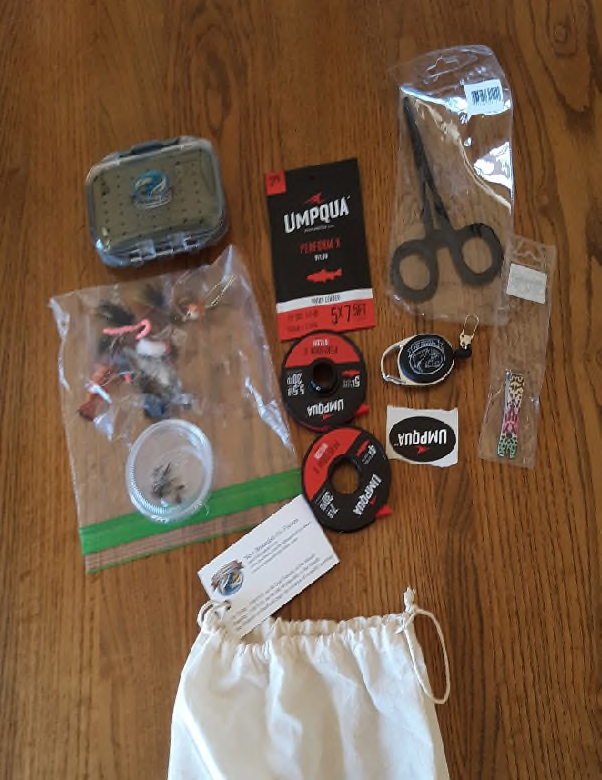
Ron said the accessories that were ordered for the GRTU Youth Camp gift bags had just arrived.  Also, he said that the response from the members for flies to include in the bag had been really good with lots of flies donated.

Ron also brought up Troutfest Texas 2023 scheduled for February 17 – 19 and wanted to know if the club wanted to do the same this time as years past.  It was decided to stay with what we have done in the past.

Dan Cone was our guest speaker.  His subject for the evening was “Nymphing the Guadalupe” but morphed into fly fishing techniques in general and tips on how to improve your skills.  It was informative and entertaining.

Dan adjourned the meeting at 8:50 pm.
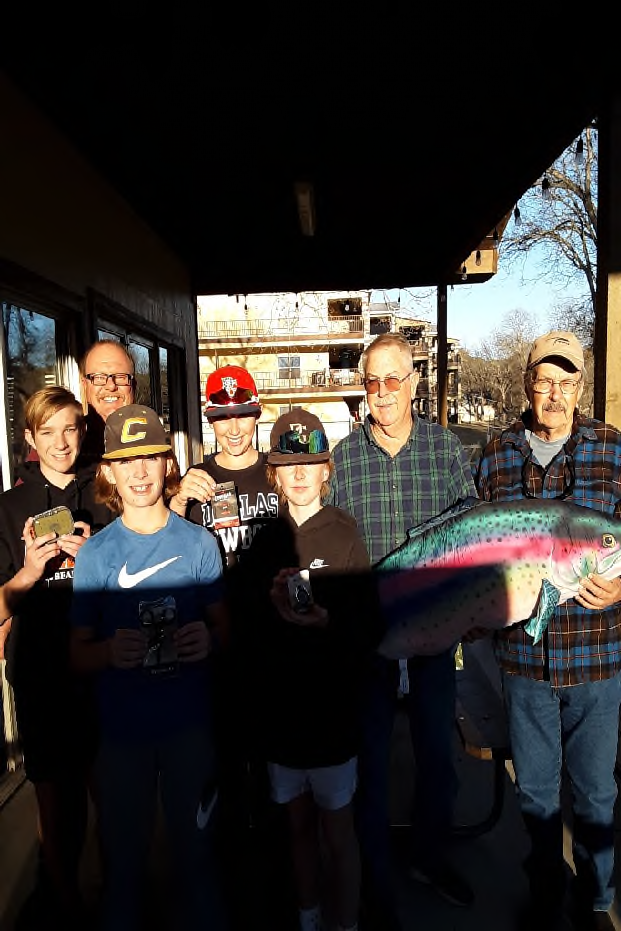
 

Next NBFF Fly Tying session is January 5th

Our next NBFF Fly Tying session will be next Thursday, January 5th., from 6-8 pm at the Westside Community Center at 2932 South IH 35 Frontage Road, New Braunfels.  In this session we will be practicing the skill of adding dubbing to your fly.  This is a skill that takes some practice to get the right amount dubbing for an accurate looking fly.  As usual, we will be tying some flies for the club meeting’s monthly fly raffles.  The club will supply the materials needed and we have tying tools for anyone needing them.
 Hope to see you there.

December Fly Fishing Report

December Fly Fishing Report

Winter is here! The temperatures have dropped and it’s a great time to get outdoors. It’s also a good time to reserve your dates for winter and spring in Texas. We’ll be targeting trout through April, and bass March through May. Check out http://actionangler.net/ to book a trip, buy some gear or gift certificate, or get up to speed on the latest river info.

RIVER CONDITIONS

The water temperatures on the Guadalupe are in the 50s. The flows on the Guadalupe below Canyon Lake are 69 CFS. There have been 6 trout stockings so far, and more on the way. Trout sizes stocked this season are anywhere from 8 inches to 27 inches. The large holdover trout are mixed in. The best way to know if you have a holdover is by the color and fin development. The Canyon Lake level is 10 feet low and flows could reduce more if rainfall doesn’t increase. Some of you may have heard that there is some construction scheduled for Canyon Dam. The dates that have been published are not firm. There will be dates changed and delays with the work. The best way to approach your fishing outing is to check the flows before you head out. Fishing locations further from the dam will notice more of a delayed change in flow. It’s very important to keep a watch on the river flows. Wading can become dangerous if you are on the river when the dam suddenly increases its flow. We recommend visiting http://www.grtu.org/flow/ to stay informed of the lake level and dam release. Make sure to book a trip soon to secure your date.

Please contact us if you want to experience some great Colorado or Hill Country fly fishing. Guided trips and gift certificates can be purchased online at http://actionangler.net/ by clicking the “BOOK NOW” button.

FLY SHOP and RIVER ACCESS

The Action Angler fly shop and river access is open 7 days a week. Purchases can be made through or website at any time of the year.

  1. Action Angler is a booking agent and guide for 1, 2, and 3 day float trips on the Gunnison River through the Gunnison Gorge and lower Gunnison River. This allows us to hold preferred dates for our clients. The Gunnison Gorge is thought of by many as a Top 20 Destination To See Before You Die, and also referred to as a mini-Grand Canyon. The lower Gunnison River is an easier-paced section, with day trips starting at $700. Please contact us for details.

  2. If you are planning to be in the Aspen or Glenwood Springs areas in the summertime or early fall, call Aspen Fly Fishing and/or Crystal Fly Shop to book trips. Be sure to request Chris Jackson as your guide. http://www.aspenflyfishing.com/ http://www.crystalflyshop.com/index.html If you are planning to be in the Crested Butte or Gunnison areas in the summertime or early fall, call Dragonfly Anglers to book trips on the upper Gunnison River and request Chris Jackson as your guide. http://www.dragonflyanglers.com/

  3. The next meeting for the New Braunfels Fly Fishers is scheduled for January 25, 2023. https://www.facebook.com/NewBraunfelsFlyFishers

  4. Guadalupe River Trout Unlimited Troutfest is scheduled for February 17-19, 2023. Go to grtu,org for more details.

  5. Our 101 and 201 classes are being planned. Please let us know of your interest, and keep an eye out for scheduled dates on our website and social media. Please email info@actionangler.net to inquire.

Thank you for supporting our small business. We hope everyone is safe and healthy during these difficult times. Sincerely,

Chris Jackson Owner/Lead Guide

Go Where the Action Is!

www.actionangler.net

830-708-FISH (830-708-3474)

Simplify your nymphing rig and catch more trout

Link to Hatch Mag post

Some years ago, when I was just a bit younger than I am now, another fly fishing guide and I were fishing a well-known Montana creek right before run-off. He was using nymphs, while I was casting a dry fly. We split up for a bit, then met up and compared notes. I was doing pretty well, but he wasn’t having much luck. Then he mentioned that he didn’t think there were many trout around.

I pointed to a little slot right in front of us where the water dropped from maybe 18 inches to 3 feet and told him to cast right there. He followed my advice, made a handful of drifts, and then declared that there were no trout in that slot.

After looking at his rig, which employed a large indicator, followed by two small indicators, with a variety of weights spread out on his leader, and finally, two nymphs, I told him that his nymph rig was the problem.

He disagreed — apparently his rig was incredibly popular in Utah at the time — and then explained how the three indicators worked in concert with the weights and the fly to ensure the perfect presentation, as well as the most trout to hand.

We argued for a bit — it turns out that he had total confidence in his set-up, while I thought it was borderline ridiculous — then finally agreed that the only way to settle our disagreement was for me to fish the same little slot.

I cut off my dry fly, tied on a couple of weighted nymphs, added a small yarn indicator in an appropriate spot on my leader and prepared to cast.

As I moved into position, my buddy reiterated that there were no fish in my immediate vicinity.

I caught a nice trout on my first cast.

I caught a nice trout on my second cast.

I caught a nice trout on my third cast.

At which point my friend mentioned that if I continued to work that slot, he was going to push me into the creek and watch me float away.


I don’t fish nymphs quite as much as I used to — I love watching trout rise to a dry fly, so dries are my preference more often than not — but I’ve followed the “advances” in nymph fishing, along with the ongoing Euro-nymphing craze, with a certain amount of interest. Here’s what I can tell you based on decades of observation and personal experience.

We make our nymph fishing far more complicated than it needs to be. Now that’s okay if we’re trying to challenge ourselves to master new techniques, or if we’re drawn to complex angling solutions. Still, I prefer simplicity when it’s a viable choice. I also like to catch fish when I use nymphs. Which is why I tend to focus on “simple nymphing.”

What is simple nymphing? To my mind, it’s nymph fishing that relies on a basic — or “simple” — nymph rig, and that employs many of the same skills we use when dry fly fishing.

When I’m nymphing, I want a rig that does five things:

  • First, it should allow me to get a natural drift at the correct depth in the water column.
  • Second, my flies should move independently of each other. (I never tie one fly directly to another fly.)
  • Third, my nymph rig should communicate immediately that something has interrupted my drift, with absolutely no hesitation or lag time.
  • Fourth, the whole set-up should be easy to create, and to adjust or modify.
  • Fifth, the rig should allow me to play and land my fish quickly and without much chance that the free hook will hang up on something.

With that in mind, let’s take a look at my typical simple nymphing rig. I start out with a standard 9’ 4X tapered leader connected to the end of a WF-5-F fly line. Then I take a 2 foot length of 4X tippet and tie it to the end of the leader using a blood knot. (We can use 3X or 5X leaders and tippet if those diameters are more appropriate for the situation at hand. We can also go lighter when we add our tippet if that’s helpful.)

I leave the tag end of the leader reasonably long — 6 inches is just about perfect — and trim the tag end of the tippet about an eighth of an inch away from the barrel of the blood knot.

To finish up, I tie an appropriately-weighted fly to the long tag, then I add another appropriately-weighted fly to the end of the tippet. If I want to fish with an indicator, I’ll place a yarn or foam indicator between the line/leader connection and the dropper fly.

Simple, right? Of course, there are a handful of details we need to concentrate on for the system to work as intended.

simple nymphing rig - fly fishing
Illustration: Hatch Magazine

FLIES

I tend to use the weighted dropper fly to get the rig down to the correct depth and the point fly to catch fish. Since I don’t really want to catch trout on the dropper fly — doing so increases the odds of tangles, or of the point fly getting hooked on a dorsal fin or tail — I’ll go larger, heavier and gaudier with the dropper fly. I may even fish a dropper fly with the point of the hook clipped off.

My point fly is typically smaller and more realistic, as well as more lightly weighted, and it usually matches something that the fish have been feeding on recently, whether that’s mayflies, caddis, midges, stoneflies, scuds or something else entirely.

My hope is that the fish will notice the larger dropper fly, check it out, refuse it, and then eat the smaller point fly trailing behind. I can’t tell you if that’s actually what happens — who knows what a fish really sees, or thinks? — but after landing thousands of trout on this set-up, and having my clients catch thousands more on the same basic rig, I have a tremendous amount of confidence in this particular approach.

SPLIT SHOT

I rarely use split shot or other weights when I’m nymphing. I can control my depth and sink rate just fine by choosing an appropriately-weighted fly for the dropper, and by the cast and/or mend I utilize. On the rare occasions when I do use split shot, I put them between the dropper fly and the point fly. I never, ever, ever put shot above the dropper fly. Why? Because I don’t want a hinge in my leader above my flies.

INDICATORS

If I decide to use an indicator, I typically opt for a small, flexible indicator made from yarn or foam, then treated with the same floatant I use on my dry flies. If the fish are spooky, I’ll go with white, gray or green. If I’m not too concerned about spooking fish, I’ll use orange or chartreuse.

I invariably adjust my indicator placement to account for the water depth, so I suggest using an indicator that will be easy to move up or down your leader.

If I’m fishing upstream, I’ll likely have 1.5 times the average water depth between my indicator and my dropper fly. If I’m fishing across stream, or across and down, I may go as short as the actual water depth between the indicator and dropper fly.

Finally, there are times when an indicator just isn’t appropriate. On those occasions I might use a dry fly as an indicator, or I might high stick my nymphs, or I might use extra floatant on the end of my fly line and watch the line the same way I’d watch an indicator.

KNOTS

I prefer a blood knot over a surgeon’s knot for attaching the tippet, as the tag end on a blood knot comes off at a 90 degree angle and seems to wrap around the leader less frequently than the tag end on a surgeon’s knot. By the way, if you clip your second tag end tight, it’s much more likely to pull loose if you stick a big fish on the dropper nymph. If you leave an eighth of an inch on that opposite tag end, the knot is far less likely to break or pull loose.

I use an improved clinch knot to attach my flies, but you can use most any knot you have confidence in.

TIPPET RINGS

Tippet rings are completely unnecessary with a simple nymphing rig. I don’t use them, and I don’t recommend them.


So what are the main advantages to this simple nymphing approach?

  1. Your rig will cast easier, and tangle less.
  2. You’ll waste less time on the water.
  3. You don’t need specialized equipment.
  4. It’s no issue to switch back and forth between nymphs, dries and streamers.
  5. It’s easy to change your dropper fly without changing your point fly.
  6. Your flies aren’t directly connected, so it’s much easier to get a natural drift.
  7. The system is extremely versatile.
  8. You’ll see your takes sooner.
  9. You’ll miss fewer fish.
  10. You’ll land more trout.

Those are all solid reasons to opt for a simple nymphing rig. Then there’s Occam’s razor, which tells us that everything else being equal, the simplest explanation — or, by extension, the simplest approach — is usually the best.

Before we wrap up, please take just a second and think about what’s really required for successful nymph fishing.

First, you need to present appropriate flies to a trout, or to likely looking water, at the right depth, and without drag or unnatural movement.

Then you need to detect the strike and set the hook before the fish expels your nymph.

That’s it.

There are any number of ways to accomplish those goals, and there’s nothing wrong with choosing a more complicated or specialized approach; for example, Euro-nymphing. But if you prefer maximum flexibility on the water, or if you like the idea of catching fish as simply as possible — without a bunch of bells & whistles — then this incredibly effective style of nymphing might be ideal for you.

We’ve focused on the rig itself, along with the benefits of this particular approach, in part one of this article. In part two, we’ll explore how we can utilize dry fly techniques to expand your on-the-water versatility and increase your nymphing success.